Updated: January 23, 2026
Every few weeks, this question comes up (via email), usually after I publish a negative review of yet another of my bittersweet Linux endeavors, which almost always revolve around Ubuntu and its derivatives, or, more specifically, Kubuntu, my distro of choice. These articles prompt my readers to challenge my choice of software. In parallel, the readers also usually recommend I try a different distro or two, which could hopefully resolve my angst and my usage problems.
The recurrence of this phenomenon prompted me to write this piece. I want to explain my rationale into why Ubuntu is the best desktop choice (and it is), why other distros aren't as optimal, and why Linux is in a bad state, regardless of what you select. Hopefully, this will settle the debate. Or perhaps make you write me even more, with yet more suggestions, so you push through my stubbornness. Well, let us commence.
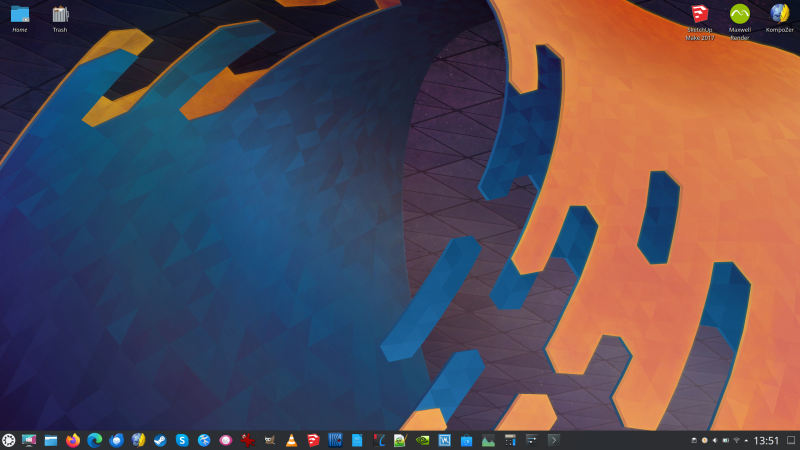
The Plasma desktop, my favorite cladding for the Ubuntu family.
Survivorship bias
Statistics is usually counterintuitive. I see this on a daily basis, including the Linux circles. Quite often, you have Linux folks justifying various design (development) decisions with things like: people like our choice of whatever, and/or most users are happy with things they are. What such statements miss is that they only cover people who are invested in the system, or choose to respond, and ignores the vast majority of people who don't use Linux at all. Thus, for instance, whatever Linux does, it's automatically not the case for 95-99% of desktop users.
This relates to Ubuntu very clearly. Ubuntu is the most popular desktop distro. Choose whatever metric you like, it has at least an order of magnitude more users than any other Tux flavor. Therefore, all other things being equal, there ought to be an order of magnitude more problems in Ubuntu than any other distro reported online. A lack of reported problems isn't an indicator of anything! I'm not quite what the sweet magical number of bugs ought to be, but I am quite sure that Ubuntu's visibility plays a large part in the equation.
A good (if somewhat unrelated) recent example that I can think of relates to Wayland adoption (with KDE). As of June 2025, the blog post mentions that approximately 73% of Plasma 6 users with telemetry turned on were running Wayland, while this number both for Plasma 5 and 6 stands at 60%. This sounds like a nice state of affairs, and you would wrongly assume that this is a useful "sway the masses" metric. We need to give credit to the KDE team for being willing to publish these numbers, but now, here's my interpretation.
- At the time of writing, no large distro used Plasma 6 as its main desktop. All Kubuntu LTS at that point were and are still using Plasma 5. It is safe to assume that the vast majority of users run these editions and not the interim ones. My guess, 10x more LTS than interim users, at least.
- We don't know what the actual value for Plasma 5 is, but even if the usage share of the two desktops is equal, that would mean that only 47% of Plasma 5 users run Wayland. However, if the Plasma 5 usage is 10x greater than Plasma 6 (which is most likely the case, if not more), then the actual usage of Wayland with the older releases is far far lower to achieve that aggregate 60%.
- And regardless, this only applies to users with telemetry turned on, so most likely developers and diehard nerds who care. In essence, I would hazard this represents 10% of users at best. Thus, in all likelihood, the Wayland adoption numbers represent 1-5% of Plasma users (5% being equal share to Plasma 6). And then, on top of that, with Linux having only a tiny desktop share (about 1% or so), and Plasma having a fraction of this share, the statistics of Wayland narrow down to maybe 0.01-0.05% of desktop users, at best. This is an approximation on my side, so take this entire paragraph with a big big grain of salt. But it shows that statistics is rather tricky to use properly.
In general, what people focus on is almost always the wrong metric, of course. It's not whether Ubuntu has bugs, or even more bugs than the next distro. It's whether Ubuntu version X has more bugs than Ubuntu version X-1. And that's really the only thing that makes sense.
But let's consider the broader landscape
You know what? Let's.
Should I perhaps use openSUSE? Well, it sort of bricked my Lenovo G50 back in the day. And it happened way before you started seeing articles blaming Ubuntu for this. It also highlights the survivorship bias element I mentioned above. How about Manjaro? Well, I had problems with Wireless connectivity on my old HP machine.
Debian-based distros? Fan, backlight problems. Distros that wouldn't even install? Check. Which ones, you ask? Well, many and varied, including those based on Red Hat and friends, and those based on Arch Linux. I've outlined roughly fifteen years of hardware problems in a dedicated article. It shows that hardware-related issues are not an Ubuntu specialty. Far from it. The issue is endemic.
And then, to make things worse:
- One version offers "decent" hardware support, then a zero-QA update arrives, breaks it.
- One version offers "decent" hardware support, then another comes and breaks it.
This is what makes it all so awful. It is the fact you can never rest, you must always be on your guard, because every little update could spell a major regression that will undo some critical functionality. You will either not have it to begin with, or it will be tragically taken away from you, almost randomly.
pm_runtime_work hogged CPU for >10000us 4 times, consider switching to WQ_UNBOUND
An example of a message that may suddenly show in your log. Oops, here come hardware problems!
Unfortunately - and fortunately - Ubuntu (and its derivatives) are no different. So if you're worried about hardware compatibility, it makes no difference really. You might actually get more traction and support with Ubuntu, as it's the most popular distro.
And then, Ubuntu also does a few things its rivals do not
For me, stability and consistency are the most important elements in the operating system design and usage. I don't want to be an unpaid administrator, I don't want to pip install anything, and if I need to do that, I am quite resentful. I also loathe installations and upgrades. I want things to be simple. So then, let's consider why Ubuntu is actually the least bad choice:
- Canonical pioneered the concept of desktop LTS. To this day, Ubuntu is really the only truly proper desktop LTS, with five years guaranteed, and another five years of pro support, which is free for home users. No one else gives you ten years of patching on your desktop, for zero cost.
- Canonical managed to make Linux more visible - by shipping millions of installation CDs worldwide. When Steam first implemented its client for Linux, it used Ubuntu libraries. It's quite likely that without Ubuntu, Linux would never have reached the critical usage level needed for this transition. Today, we can all feel cushty there's Proton and Steam Deck and all that. But it wasn't a given. And a decade back, Ubuntu was the catalyst.
- As you can infer from my first point, Ubuntu is a commercial product.
- The availability of software for Ubuntu in the home space (not enterprise space, mind) exceeds other distributions. Combined with its popularity and online footprint, this means if you need to solve a problem, you will most likely use an Ubuntu-themed thread, post or tutorial to get your job done.
- To this day, the good ole Ubuntu Software Center remains the only practical application of a paid store for Linux, where you could actually buy stuff. A decade later, we still don't have that. A major regression. Neither the Snap Store nor Flathub offer this. Speaking of, the Snap Store is part of Canonical's product line, so if something goes wrong, you have an actual entity to blame. And things will go wrong.
- On the security front, Ubuntu is robust. As a good example, Ubuntu didn't merge the backdoored xz code to its production repos. I find this quite important. Critical even. You may do your own reading to see what happened, how, when and why.
Now, there are many, many problems in Ubuntu. And newer Ubuntus are slowly becoming worse than older Ubuntus. The same applies to most other flavors, like Kubuntu, Xubuntu, etc. Alas, peak desktop was 2014-2015 or so, and since, we only have rehashed ideas, more software bloat, and more bugs. The one exception to this would be the Plasma desktop (but not always its implementation in Kubuntu), but even so, the situation is quite fragile. I've yet to witness a Linux product with as few as three consecutive releases offering the same level of stability and maturity, without any random breakages.
When I take into consideration all these different parameters, to me, Ubuntu, whether you choose the main version, one of the flavors, or custom-build your own little edition, if needed, offers the most comprehensive package of support, updates, security, software availability, and quality. It could do more, a lot more, but as it stands, it already does more than most if not all other distros.
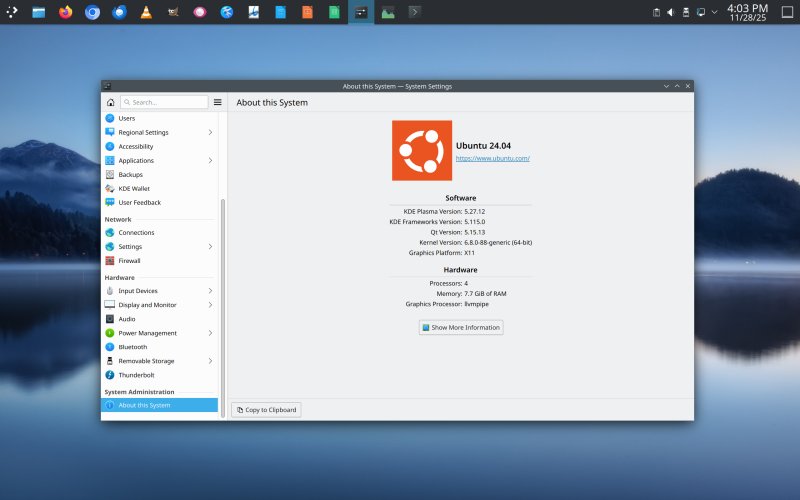
Surprisingly, or not, adding Plasma to the Server edition does wonders.
Conclusion
Do I wish things were different? Immensely so. Since roughly 2005 or so, I've been waiting for Linux to become the "thing" on the desktop. And for a brief while, around 2010-ish and change, it looked as if this might actually happen, and again, primarily thanks to Ubuntu. But neither the demise of Windows XP, nor 7, nor 10 (at least for now) have made much difference. And as time goes by, it becomes harder to retain enthusiasm. It's not that the desktop has become less relevant. You can see the fatigue. How many releases of a distro can you release, with no discernible change? What's the point? In this regard, I think Linux folks are making it extra harder for themselves. If you release say four versions and nothing happens, you are disappointed four times. But if you release twenty versions, with eighty editions, and still nothing happens, the pain grows orders of magnitude.
I digress. Ubuntu is the least bad choice overall in the Linux world. Come to think of it, I used SUSE when it was still Novell. I switched to Ubuntu thereafter. I like the notion of an actual company making decisions, for better or worse. Community efforts are a nice thing, as long as you want to play by the community rules. Step out of that ring, and you're a pariah. I'm too old to play such games. And purely on the hardware and software side, I'm certain no other distro (family) can deliver as much.
It should be more, much more, but it's still better than what other distros do. Sure, here and there, you get a spot of brilliance from Fedora, Manjaro, Antergos, MX Linux, or alike. However, when you take all things together - security, long-term support, ease of use, and such, Ubuntu still comes on top. There's also the prospect of future stability. Small distros come and go. I can't afford that to be part of my productivity plans. And finally, the technical problems that plague this distro are not Ubuntu-specific. Fragmentation, dev-focused nonsense, lack of QA, lack of product, lack of philosophy, lack of aesthetics. Welcome to the wild, wild world of Linux. From your dearest fan and critic, peace.
Cheers.